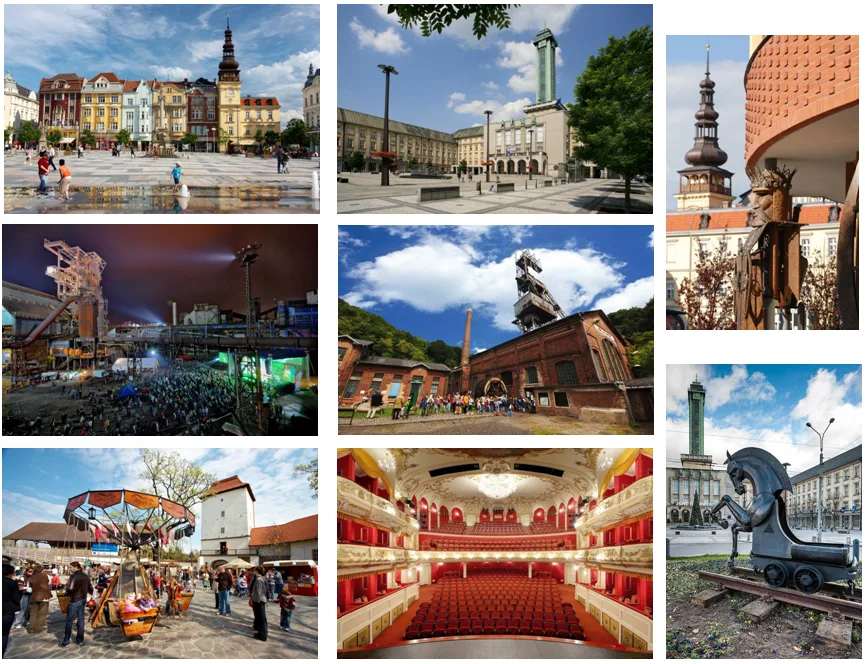
Ostrava
City guide · Moravian-Silesian Region · Czechia
Lower Vítkovice industrial complex · Colours of Ostrava music festival
About Ostrava
Ostrava is a city in the northeast of the Czech Republic, capital of the Moravian-Silesian Region, near the Polish border at the confluence of four rivers: Oder, Opava, Ostravice, and Lučina. It is the third largest city in the country by population and area, the second largest in Moravia, and the largest in Czech Silesia, straddling the historic border of Moravia and Silesia. Once known as the 'steel heart' of Czechoslovakia due to its coal-mining and metallurgical past, Ostrava has transformed since the Velvet Revolution, with the last coal mined in the city in 1994. Today, remnants of its industrial heritage, such as the Lower Vítkovice area, a former coal-mining, coke production, and ironworks complex, remain visible. The city hosts cultural events like the Colours of Ostrava music festival, Janáček May classical music festival, Summer Shakespeare Festival, and NATO Days, and is home to two public universities: the Technical University of Ostrava and the University of Ostrava.
Who this destination fits
Highlights worth planning around
Strong fit
- Rich industrial heritage with unique sites like Lower Vítkovice
- Vibrant cultural scene with annual festivals like Colours of Ostrava
- Largest urban area in Czechia outside Prague, offering diverse attractions
- Home to two public universities, adding a youthful energy
Tradeoffs
- Industrial past may not appeal to all travelers
- Less well-known internationally compared to Prague, potentially fewer tourist amenities
Plan the trip
Best time to visit
Summer for festivals like Colours of Ostrava; year-round cultural events
Planning lead time
2-3 days
Decision factors
Getting around
Located near Polish border; accessible by road and rail; city has public transport
Trip Budget Calculator for Ostrava
Estimate your travel expenses based on duration, style & group size
Global planning baseline. Flights use a generic estimate.
* Commission may be earned from qualifying partner bookings.