Trieste
City guide · Friuli-Venezia Giulia · Italy
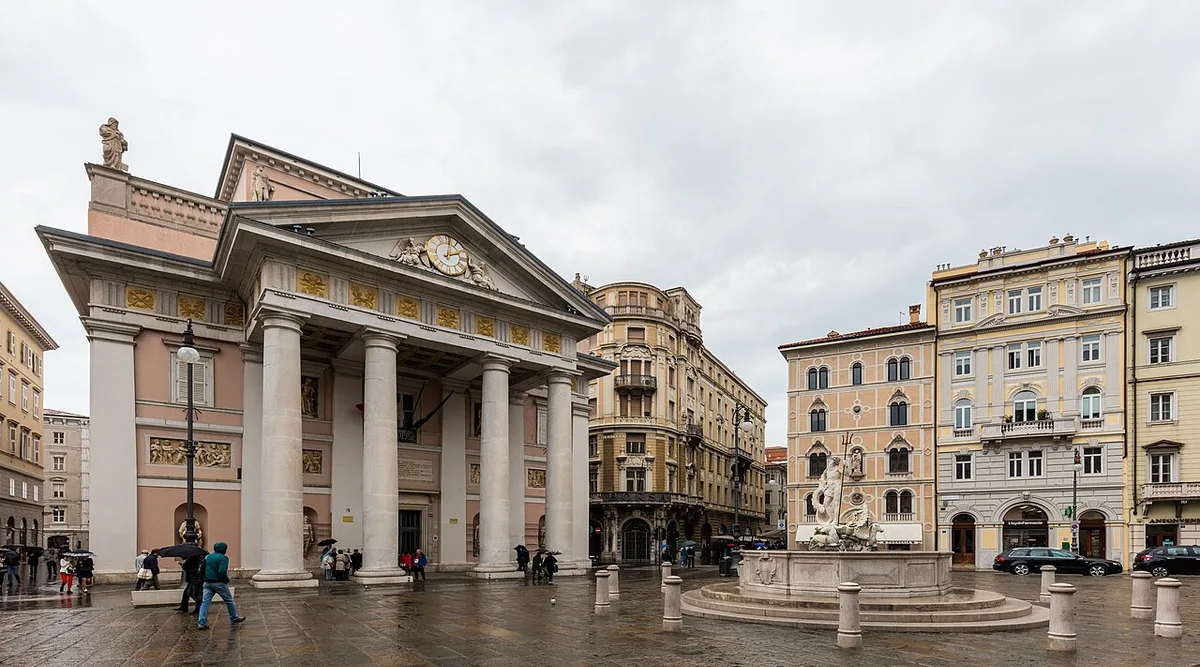
Piazza Unità d'Italia - the grand seafront square, widely considered the largest seafront square in Europe · Miramare Castle - perched on a rocky promontory overlooking the Adriatic Sea, built by Archduke Maximilian of Habsburg, completed in 1860
About Trieste
Trieste is a city and seaport in northeast Italy, capital of the autonomous region of Friuli-Venezia Giulia. It sits at the head of the Gulf of Trieste on a narrow strip of Italian territory between the Adriatic Sea and Slovenia, with Slovenia about 8 km east and Croatia about 30 km south. The city has a long coastline and is surrounded by grassland, forest, and karstic areas. Trieste belonged to the Habsburg monarchy from 1382 until 1918 and was its most important seaport in the 19th century, growing into the fourth largest city of the Austro-Hungarian Empire. Today it is a deep-water port and maritime gateway for northern Italy, Germany, Austria and Central Europe, and since the 1960s has emerged as a prominent research location. The city lies at the intersection of Latin, Slavic and Germanic cultures, where Central Europe meets the Mediterranean Sea. It is known for its grand neoclassical architecture, the vast seafront Piazza Unità d'Italia, a deeply ingrained cafe culture, and the rugged Karst plateau rising behind it.
Who this destination fits
Highlights worth planning around
Strong fit
- Unique cosmopolitan atmosphere at the crossroads of Latin, Slavic and Germanic cultures
- Grand neoclassical architecture alongside ancient Roman ruins
- Vast Piazza Unità d'Italia opens directly onto the Adriatic Sea, a sight unlike any other in Europe
- Deeply ingrained cafe culture that once inspired literary giants like James Joyce
- Rugged Karst plateau rises dramatically behind the city, offering spectacular coastal views
- High concentration of researchers per capita in Europe, giving the city a scholarly character
- Deep-water port serving as a maritime gateway for Central Europe
Tradeoffs
- The fierce Bora wind can blow so strongly that the city previously installed ropes along pavements to help pedestrians stay upright
- The city's atmosphere is often described as elegant and melancholy, which may not suit travelers seeking a typical lively Italian beach destination
- The 20th century brought profound upheaval, including occupation and tragedy during the Second World War, and the city contains the only Nazi extermination camp built on Italian soil, now a national monument
- After Italian annexation following World War I, the port lost its vast imperial hinterland
Plan the trip
Best time to visit
Spring offers pleasant weather for hiking trails on the Karst plateau. Summer brings a relaxed coastal lifestyle with locals sunbathing at Barcola beach. Autumn peaks in October with the Barcolana regatta. Winter sees the Bora wind and a focus on the cafe culture.
Planning lead time
3 days recommended to absorb the cafe culture, explore central squares, dedicate a half day to Miramare Castle, and venture up to the Karst plateau.
Decision factors
Safety
No specific safety concerns were identified in the grounded evidence sources.
Getting around
The city has a famous historical tram line that converts into a funicular railway to conquer the steep elevation of the nearby Karst plateau. The port handles more goods than any other in Italy, serving as a vital maritime gateway for Central and Eastern Europe.
Trip Budget Calculator for Trieste
Estimate your travel expenses based on duration, style & group size
Global planning baseline. Flights use a generic estimate.
* Commission may be earned from qualifying partner bookings.