Arequipa
City guide · Southern Peru · Peru
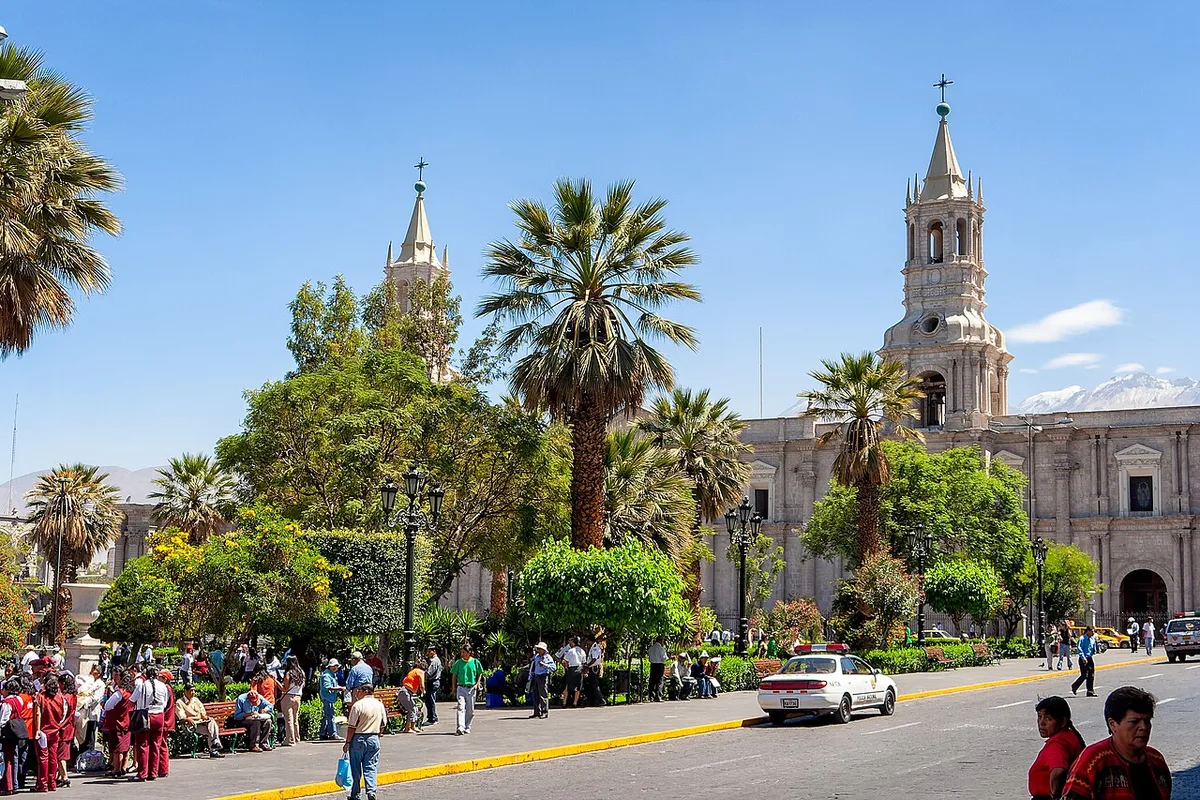
Historic Centre of Arequipa, a UNESCO World Heritage Site inscribed in 2000 · Plaza de Armas with the Cathedral of Arequipa
About Arequipa
Arequipa is a city in southern Peru and the capital of Arequipa Province and the Department of Arequipa. With a projected population of 1,195,700 in 2025, it is the country's second most populous city after Lima. It is the official seat of the Constitutional Court of Peru and is known as the 'Legal Capital of Peru'. The city extends along both banks of the Chili River, in the Arequipa or Chili valley, bordered by the Andes to the north and east and by low coastal hills to the south and west. The site was founded on 15 August 1540, when it was named 'Villa Hermosa de Nuestra Señora de la Asunta de Arequipa'. In 2000, UNESCO inscribed 332 hectares of Arequipa's historic center as a World Heritage Site. Its and monumental heritage, together with its scenic and cultural spaces, has made it a destination for national and international tourism. In the historic area, viceregal and republican architecture is preserved, earning it nicknames such as the 'White City' and 'Jewel of Viceregal Architecture'.
Who this destination fits
Highlights worth planning around
Strong fit
- UNESCO World Heritage Site with well-preserved historic center (inscribed 2000)
- Known as the 'White City' for its distinctive sillar stone architecture
- Second most populous city in Peru with a projected population of 1,195,700 in 2025
- Official seat of the Constitutional Court of Peru, known as the 'Legal Capital of Peru'
- Peru's second most industrialized city and one of its most economically active urban centers
- Connected by the Southern Railway with the port of Matarani and the cities of Cusco and Puno
- Maintains commercial links with Chile, Bolivia, and Brazil
Tradeoffs
- Located in a seismically active area near the Misti volcano, which may concern some travelers
- High altitude (approximately 2,335 meters above sea level) may cause altitude sickness for some visitors
- Arid climate (classified as BWk, temperate arid) means limited rainfall and dry conditions
- As a major city, it can be busy and less intimate than smaller Peruvian towns
- Some attractions may require planning due to distance from other major tourist hubs
Plan the trip
Best time to visit
The city has a temperate arid climate (BWk). The dry season (roughly May through September) generally offers clearer skies and is often recommended for visiting. However, specific current seasonal conditions should be verified closer to travel dates.
Planning lead time
A few days to a week is typically sufficient to explore the historic center and nearby attractions, though longer stays allow for deeper exploration of the region.
Decision factors
Safety
As with any major city, travelers should exercise standard precautions. The city is a major economic and political center. Specific current safety conditions should be verified with up-to-date local sources before travel.
Getting around
Arequipa is connected by the Southern Railway with the port of Matarani and the cities of Cusco and Puno. The city maintains commercial links with Chile, Bolivia, and Brazil. Specific current transport schedules and options should be verified closer to travel dates.
Trip Budget Calculator for Arequipa
Estimate your travel expenses based on duration, style & group size
Global planning baseline. Flights use a generic estimate.
* Commission may be earned from qualifying partner bookings.