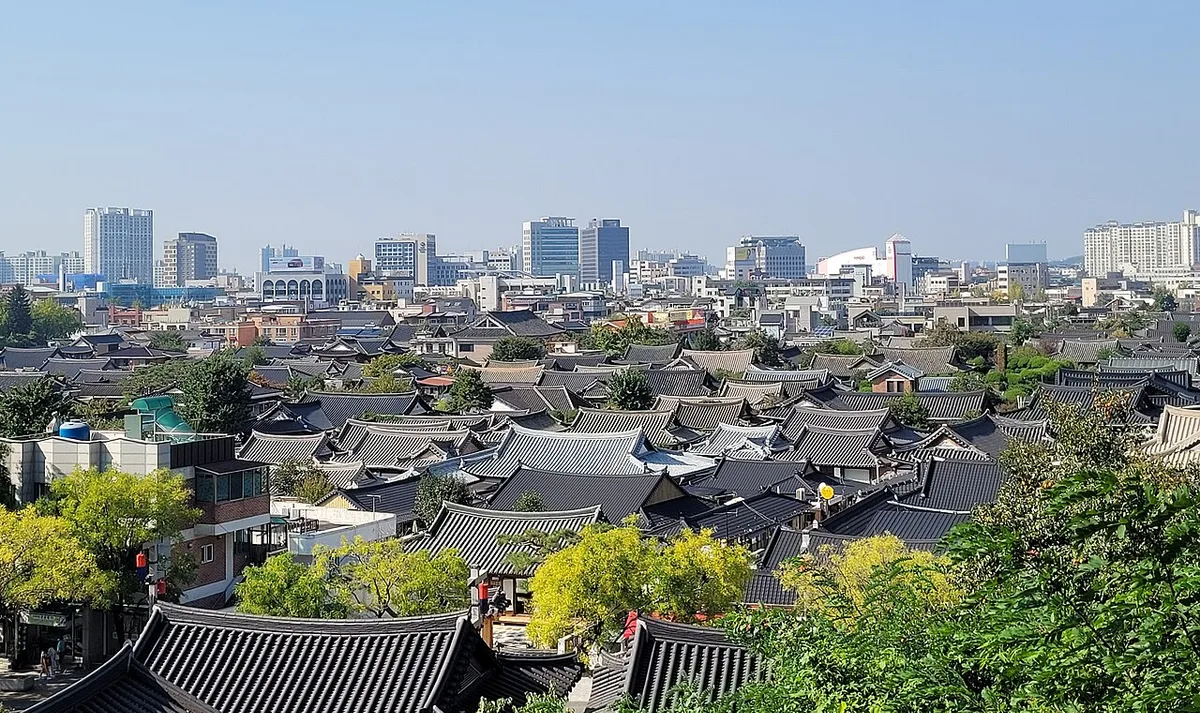
Jeonju
City guide · Jeonbuk (North Jeolla) Province · South Korea
Jeonju Hanok Village · Jeonju National Museum
About Jeonju
Jeonju is the capital and largest city of Jeonbuk (North Jeolla) Province, South Korea, with a population of 638,421 as of February 2026. It is a city with over 1,300 years of history and culture, known for its traditional cuisine, historic buildings, and festivals. In May 2012, Jeonju was designated a UNESCO Creative City for Gastronomy, recognizing its traditional home cooking, food research, chef training, and distinctive food festivals. The city is primarily situated in a basin surrounded by mountains, with the Jeonjucheon River flowing through the center as a major ecological axis. Jeonju is divided into two wards, Deokjin District and Wansan District, which are further divided into approximately 40 neighborhoods. The city has a humid subtropical climate (Köppen Cwa) with four distinct seasons; spring (late April through May) and fall (after September 25 through October) typically have temperatures in the mid-20s°C with low humidity. Traditional tourism and sightseeing are major industries in the city, which lacks the heavy industrial infrastructure found in other major Korean cities.
Who this destination fits
Highlights worth planning around
Strong fit
- Designated UNESCO Creative City for Gastronomy in May 2012, recognizing the city's traditional home cooking, active food research, chef training system, and distinctive food festivals
- Over 1,300 years of history and culture, with the city having produced many scholars and developed a publishing industry
- Four distinct seasons with pleasant spring and fall temperatures in the mid-20s°C and low humidity
- Traditional tourism and sightseeing are major industries, offering a less industrialized experience compared to other major Korean cities
Tradeoffs
- Summer months (June through September) bring humidity from Southeast Asia, with July and August receiving the highest precipitation (302.8 mm and 289.6 mm respectively)
- Winter can include quite cold days influenced by high pressure fronts bringing cold air from Siberia, with January mean daily minimum of -4.3°C
- Lacks the industrial infrastructure, manufacturing, and heavy industries found in other major Korean cities, which may limit certain urban amenities
Plan the trip
Best time to visit
Spring (late April through May) and fall (after September 25 through October) when temperatures are often in the mid-20s°C with low humidity
Trip Budget Calculator for Jeonju
Estimate your travel expenses based on duration, style & group size
Global planning baseline. Flights use a generic estimate.
* Commission may be earned from qualifying partner bookings.


